Memmingen Airport considers itself responsible for improving clean air and reducing noise pollution through the use of low-emission technologies. One important contribution involves the airport fleet’s gradual conversion to drives powered by renewable energies: electric and gas – and in future – hydrogen.Fleet management faces major challenges in terms of financial and day-to-day operational issues, especially for specialised vehicles used in winter services and de-icing operations. It is also important to be able to provide a functioning charging infrastructure. There are many different charging points in the security area, which are used by the car fleet as well as by aircraft and luggage tugs, cleaning machines, e-scooters, etc.There is an e-charging station on the access road to the airport in the immediate vicinity of the terminal, which is popular with passengers, drop-offs & pick-ups, as well as local residents, service providers and employees.The aim is to steadily expand e-mobility, on land & in the air.
Fleet management faces major challenges with regard to financial and day-to-day operational issues, particularly when it comes to specialized vehicles used by the fire department, grounds management, and winter maintenance/de-icing.
The vehicle fleet is being largely electrified, as the transition to renewable energy in operations and for machinery is a key driver for reducing CO2 emissions.
Similarly, all of the airport’s diesel vehicles are fueled with HVO100. The baggage carousels and GPUs run on Shell’s synthetic GTL fuel.
It is important to have a functional charging infrastructure in place:
Numerous electric charging points are available in the security area, which are used by various vehicles, including the passenger car fleet, aircraft and baggage tugs, cleaning machines, and e-scooters.
For service vehicles and private cars, 220-volt charging stations are available in various employee parking lots. In addition, several specially marked parking spaces with charging points have been set up around the rental car center.
A large electric charging station is located on the access road to the airport, in the immediate vicinity of the terminal. It is used equally by passengers, those dropping off and picking up passengers, as well as by residents, service providers, and employees. The charging stations are powered by electricity from the airport’s own photovoltaic system.
| Proportion of vehicles to be refuelled in the total fleet FMM + Allgate ... | 2022 | 2023 | 2024 | 2025 |
|---|---|---|---|---|
| ...with electric drive | around 25% | around 31% | around 33% | around 40% |
| ...with natural gas drive | around 7% | around 8% | around 5% | around 8% |
| ...with synthetic diesel | around 11% | around 11% | around 10% | around 6% |
Charging station 1 with 215 kW total output, has 4 charging points:
Charging point 1 & 2: CCS-Typ2 plug 150kW DC
Charging point 3: Type2 socket 22kW AC
Charging point 4: Type2 plug 43kW AC
All 4 charging points can be used at the same time.
Charging station 2 with 215 kW total output, has 6 charging points:
Charging point 1 & 2: CCS-Typ2 plug 150kW
Charging point 3: Type2 socket 22kW AC
Charging point 4: Type2 plug 43kW AC
Charging point 5: CHAdeMO plug 50kW DC
Charging point 6: Tesla plug 50kW DC
4 charging points can be used at the same time.
Performance data:
Module field 1
Rooftop building (bunker)
255 modules 300Wp = 76.5kWp
Module field 2
Roof carport system
78 modules 300Wp = 23.4kWp
Overall performance
Module fields 1 and 2
99.9kWp
2021: 5 per day
2022: 8 per day
2023: 13 per day
Additional charging stations are available behind the Airport Service Center.
During your stay at the airport, you can charge your vehicle there for a maximum of two hours. No parking fees apply for the duration of the charging process.
To take advantage of the free parking time, please present proof of the start and end times of the charging process from your charging app, as well as the parking ticket you received upon entry, at the information desk in the Airport Service Center. After successful verification, your parking ticket will be validated.
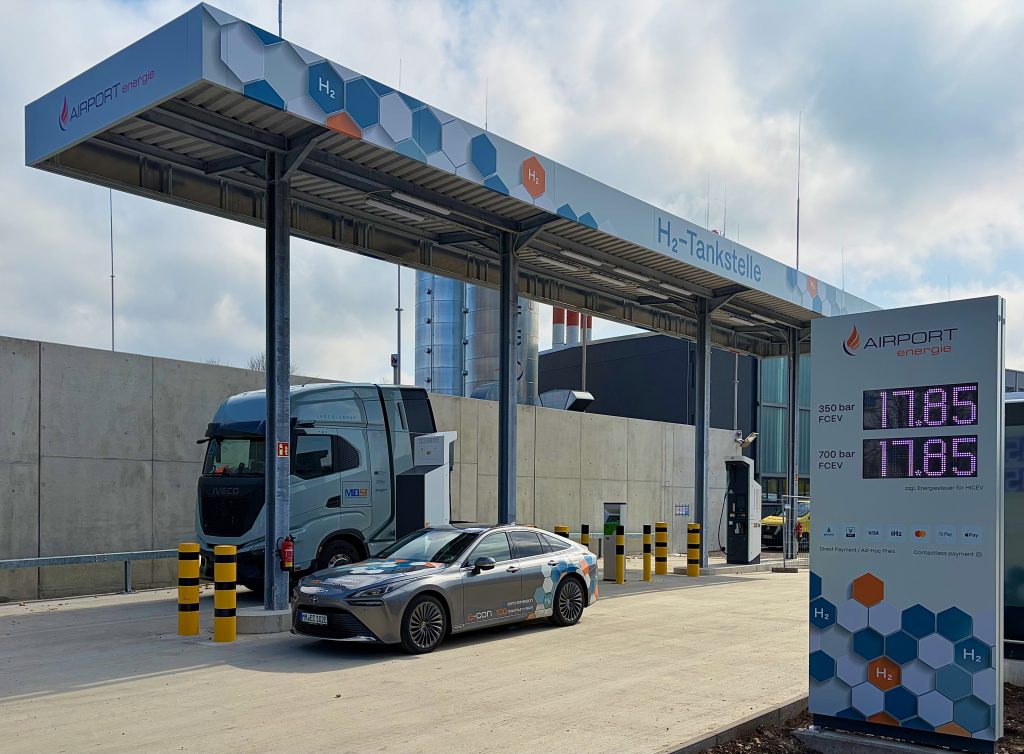
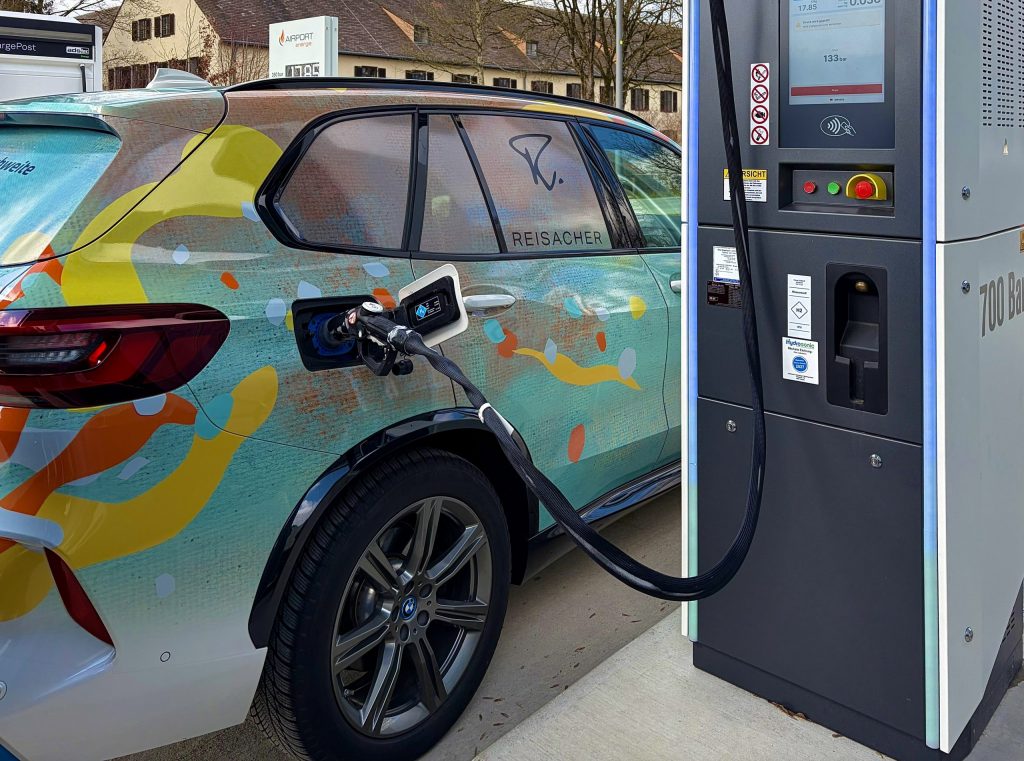
Memmingen Airport is continuing to expand its infrastructure for alternative propulsion technologies: Since April 2026, Airport Energie Management GmbH (AEM) has been operating a publicly accessible hydrogen refueling station at the airport. This provides a refueling option for hydrogen-powered vehicles at the site.
The project was funded by the Bavarian State Ministry of Economic Affairs, Regional Development, and Energy as part of the Hydrogen Alliance. The H2 refueling station offers green* hydrogen.
The new refueling station creates the necessary infrastructure for the use of hydrogen-powered vehicles at the site. It can be used by trucks, buses, passenger cars, and suitable special-purpose airport vehicles, among others. In this way, the airport is expanding the possibilities for the use of alternative propulsion technologies in road and airport traffic.
Overview of hydrogen refueling stations in Germany: https://www.klimafreundliche-nutzfahrzeuge.de/praxis/tank-und-ladeinfrastruktur/
(*Proof available upon request)
Advantages of Hydrogen Mobility
Suitable for all types of vehicles—trucks, buses, passenger cars, and specialty vehicles
Two dispensers with pressures of 350 and 700 bar to meet different vehicle requirements
Low-noise operation; no direct CO2 emissions from the vehicle during use—a benefit for the environment and health
Positive impact on ESG reporting—strengthens sustainable corporate strategy
Short refueling times—similar to those of conventional internal combustion engines
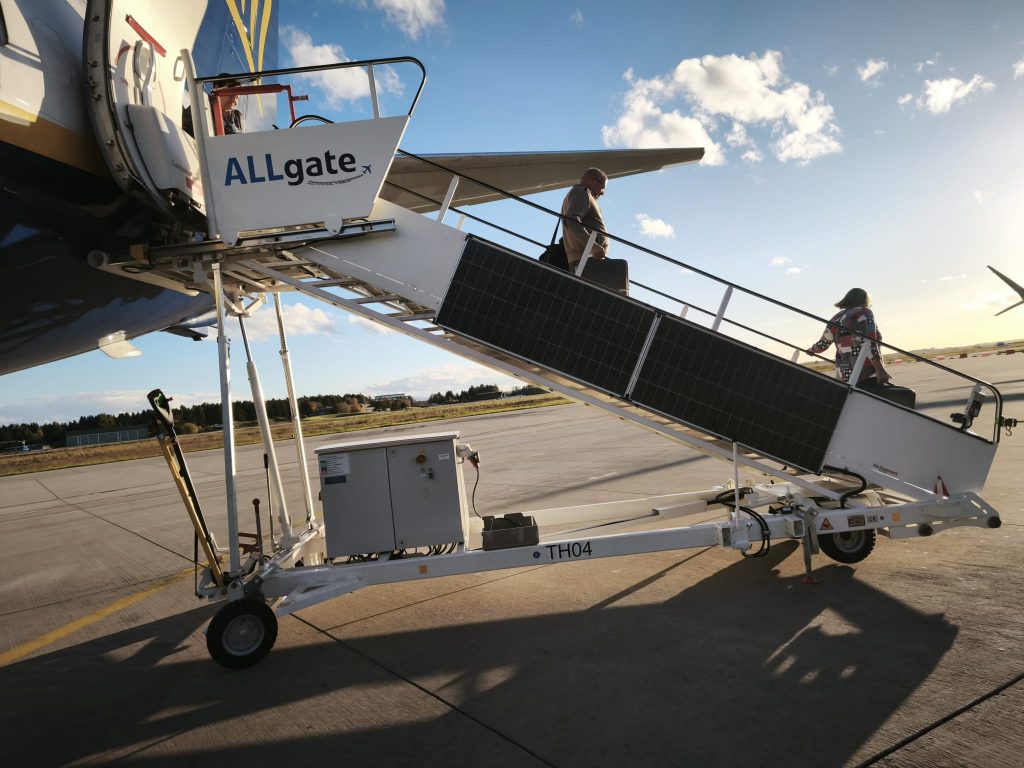
Memmingen Airport has had two new passenger stairs in operation since fall 2025.
Advantages
With this purchase, we are investing in efficiency, safety, and environmental protection.
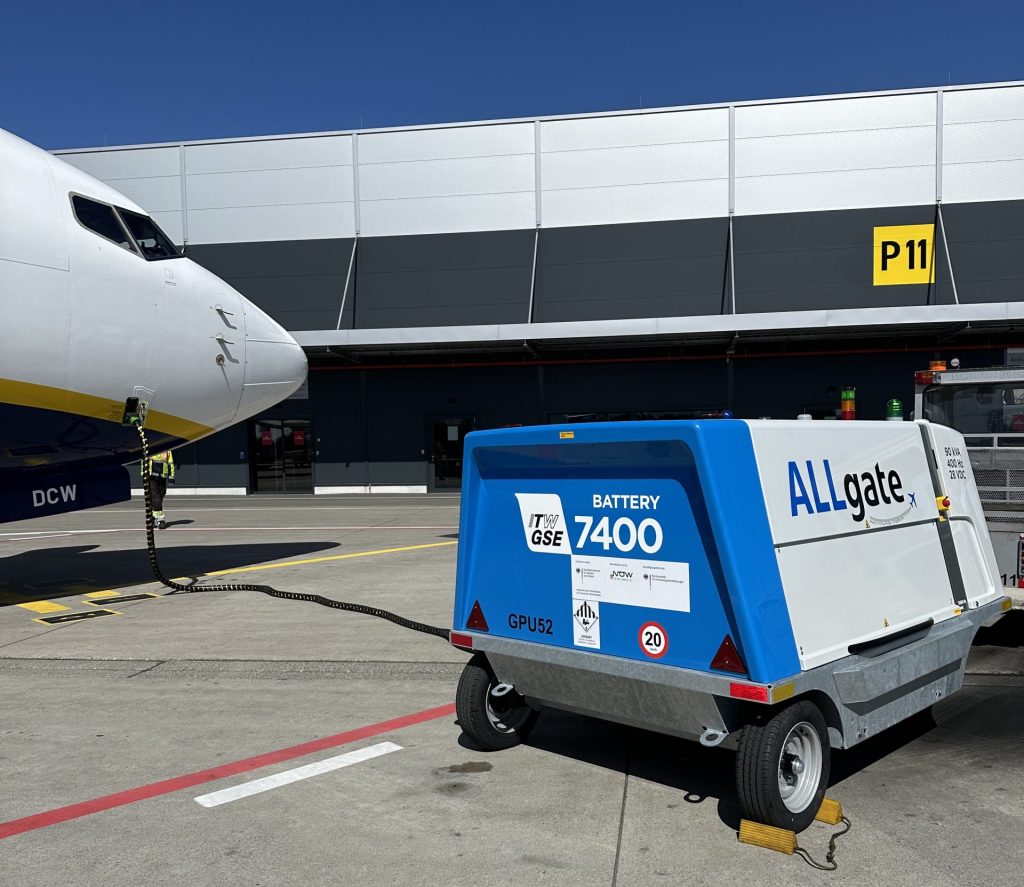
Parked aircraft require electricity for systems such as onboard computers, air conditioning, and lighting. Since 2025, Memmingen Airport has been using battery-electric ground power units (eGPUs) to provide this service.
These eGPUs replace units that previously ran on synthetic diesel fuel. Since the battery-electric units do not burn fuel during operation, they generate no exhaust emissions on-site. They also operate more quietly than the units they replaced.
With this switch, the airport is electrifying another segment of its ground handling operations. At the same time, the provision of electric ground power supports the objectives of the European Alternative Fuels Infrastructure Regulation (AFIR), which sets requirements for the power supply to stationary aircraft at airports within the Trans-European Transport Network.
The acquisition for FMM was funded with a total of just under €560,000 by the Federal Ministry for Digital and Transport under a program designed to stimulate the market for alternative technologies for climate- and environmentally friendly ground power supply to aircraft at airports. The funding guidelines are coordinated by NOW GmbH, while applications are approved by the Federal Agency for Administrative Services.
In 2026, Allgate GmbH, a subsidiary of Memmingen Airport, also received a grant under the funding program for climate- and environmentally-friendly ground power supply for aircraft.
You need to load content from reCAPTCHA to submit the form. Please note that doing so will share data with third-party providers.
More InformationYou are currently viewing a placeholder content from Turnstile. To access the actual content, click the button below. Please note that doing so will share data with third-party providers.
More InformationYou are currently viewing a placeholder content from Facebook. To access the actual content, click the button below. Please note that doing so will share data with third-party providers.
More InformationYou are currently viewing a placeholder content from Instagram. To access the actual content, click the button below. Please note that doing so will share data with third-party providers.
More InformationYou are currently viewing a placeholder content from X. To access the actual content, click the button below. Please note that doing so will share data with third-party providers.
More Information